

In a ridiculously choreographed season premiere of 60 minutes , Norah O’Donnell sat across the table from a colonel the Pentagon will only call Bravo. The Cooper who sat in the same package and waved away a munitions crisis was Adm. Brad Cooper, commander of U.S. Central Command — not Anderson Cooper. Get them right and the official story still has holes large enough to fly an F-15 through.
What Washington sold was a war film. On the night of April 2–3, 2026, an F-15E Strike Eagle from the 494th Fighter Squadron, call sign Dude 44, was flying a strike against industrial sites tied to Iran’s missile and drone programs when an Iranian shoulder-fired missile hit the jet. Both men ejected. The pilot, Alpha, came down about five miles from his weapons-systems officer. Alpha was pulled out in daylight within hours. Bravo spent roughly two days on a ridgeline in the Zagros with a broken back, a broken arm, a broken shoulder, a sprained ankle, a pistol, a radio, and a prayer. Ninety Americans walked into Iran to get him. Hundreds more flew cover. Cooper put the total supporting cast near five thousand. Hegseth, Caine, and Cooper then sat for the same cameras five months later and called it a modern miracle.
That is the version that aired. It is also the version the Pentagon had to work to get on air. CNN — the actual CNN reporting, not the interview people keep misnaming — documented that Hegseth’s political shop pushed both crewmen to appear, that both initially resisted, that Hegseth sat down with them privately after the pushback, and that Alpha still refused. The Pentagon called the report “a complete lie” and said the choice belonged to each pilot. One man on camera and one man off camera is not a denial. It is the product. An unpopular war needed a clean win. This was the clean win.
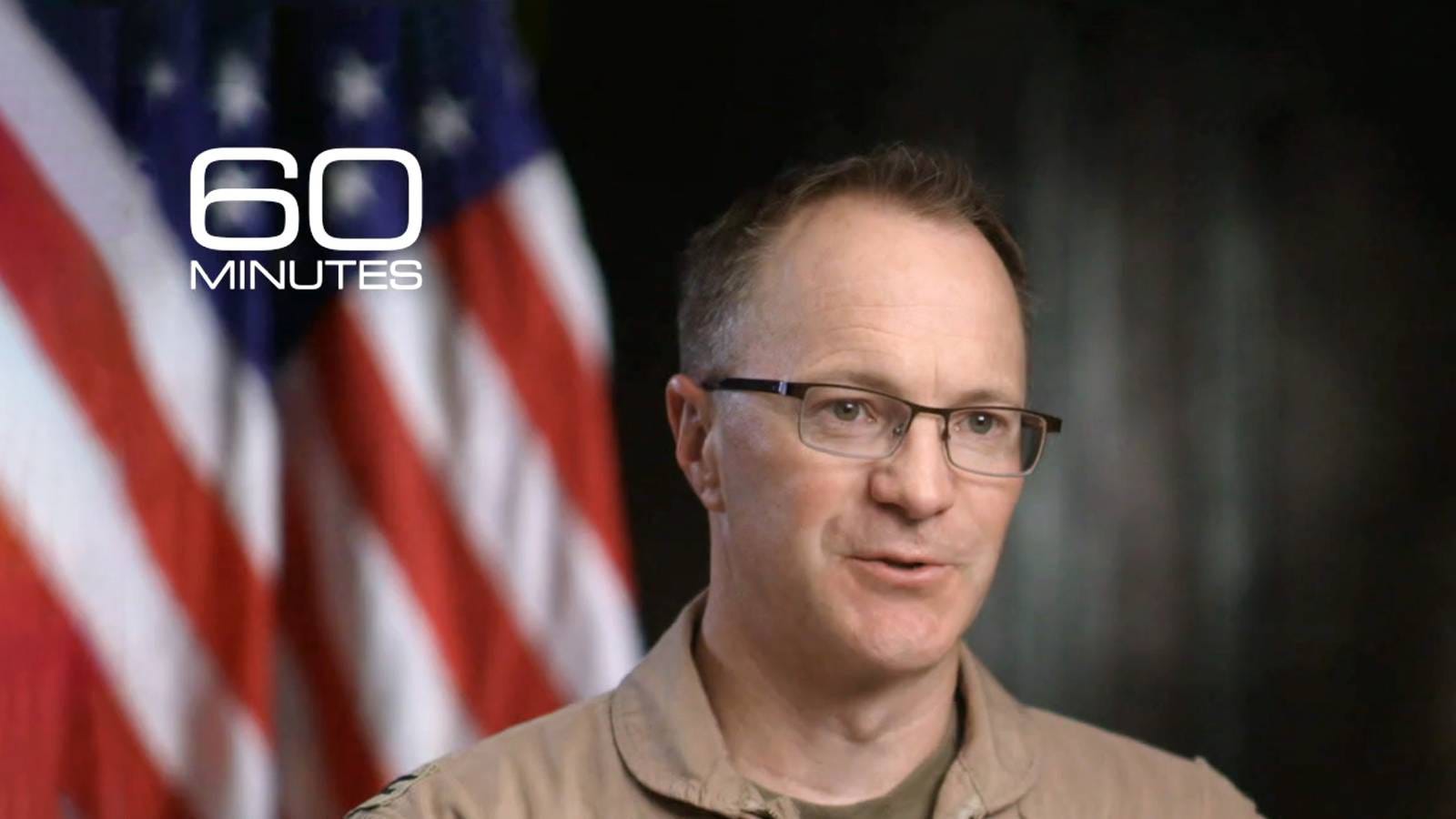
Bravo on 60 Minutes. Nametag taped, 494th “Panthers” patch still on the shoulder, American flags behind him. That is the image the administration wanted circulating in September. It is not a small image. By the time the segment ran, the war that began on February 28 had already produced the first American fighter lost over Iran in this conflict, an A-10 damaged on the rescue, two C-130s destroyed on a dirt strip, 18 U.S. dead and more than 800 wounded in the figures that traveled with the broadcast, and oil prices that had done more damage to the home front than any Iranian communiqué. A colonel in a tan flight suit is cheaper than a strategy.
What actually happened in April, before the studio lights
The jet came down. That part is not a rumor. Iranian state media put wreckage on camera the same morning: a vertical stabilizer consistent with a Europe-based F-15, an ACES II ejection seat with the stencil still readable, scorched electronics in the dirt. CNN’s own military analysts said that day the debris matched an F-15E, not the F-35 Tehran first claimed. U.S. sources confirmed two crewmen down and a search under way. Iran put a bounty on them and told locals to hunt. One helicopter taking Alpha out took small-arms fire. An A-10 covering the rescue was hit and its pilot got the jet out of Iranian airspace before ejecting. Trump announced Bravo’s extraction on Truth Social: “We got him.” He later said the United States flew dozens of aircraft over Iran for hours in daylight. Other tallies put the package near 155 aircraft — fighters, tankers, bombers, rescue birds. That is not a two-man pickup. That is a raid.
The crew were from RAF Lakenheath’s 48th Fighter Wing. Bravo is a colonel. Air Force colonels who still fly the back seat of an F-15E are not twenty-five. They are men in their forties or early fifties who have spent two decades in the community. The viral clips that treat his face as proof he is “dying of old age” are doing the work of a punchline, not an argument. He looks like a colonel. That is the least interesting fact in the tape.
The interesting facts start with the weapon, the fall, the ridge, the map, and the admiral’s inventory.
A freight train is not a shoulder tube
60 Minutes needed the contrast. A $30 million jet, a $100,000 missile. David and Goliath with the roles reversed, American Goliath on the ground praying. Bravo said the impact felt like a freight train. That line has been repeated in every write-up since Sunday as if simile were ballistics.
A MANPADS can kill an F-15. That is not fantasy and people who say it is are not helping. Iran fields the Misagh family. U.S. officials later told NBC a Chinese-origin shoulder-fired system was the likely shooter, possibly cued by a long-range radar Tehran received after the war started. The FN-6 class and its cousins live in a small box: a few miles of range, a ceiling that is useless against a jet at 30,000 feet and lethal against a jet in a valley. Strike profiles in the Zagros — low, between ridges, hunting mobile launchers — put a hot engine inside that box. A retired fighter pilot said as much in April. Sandboxx’s reconstruction said the same thing: once you have beaten the S-300s you still have to play whack-a-mole with tubes on ridgelines. An F-35 had already taken a MANPADS hit earlier in the war. Dude 44 was not the first American aircraft in this conflict to learn that air superiority is not Kansas.
What does not sit cleanly is the rest of the sentence. Shoulder-fired missiles have small warheads. They kill by proximity blast, fragment, or a hit on a hot tailpipe. They do not usually announce themselves as a locomotive unless the aircraft was already low, slow, and close — which is exactly the profile a MANPADS needs, and exactly the profile that makes Cooper’s “we had air superiority” line a talking point rather than a fact. He told O’Donnell they were not flying over Kansas. He also told her the target was industrial facilities for drones and missiles, “not related to the Isfahan nuclear facility,” while placing the mission south of Isfahan, “close to where Iran had been keeping much of its highly enriched nuclear material.” Those two sentences want to be believed at the same time. They cannot both be as casual as he made them sound.
The wreckage Iran showed the world was a tail and a seat, not a reconstructed missile. No American public briefing has produced the seeker head, the motor casing, or the radar track that would lock the weapon type the way 60 Minutes locked it. “Shoulder-fired” is the politically useful answer. It makes Iran look lucky and cheap. It makes the United States look unlucky and brave. A longer-range system would raise other questions about how a jet with one of the better electronic-warfare suites in the inventory flew into a prepared shot.
Iranian media’s debris was enough to identify the family of aircraft. It was not enough to close the forensic file 60 Minutes treated as closed.
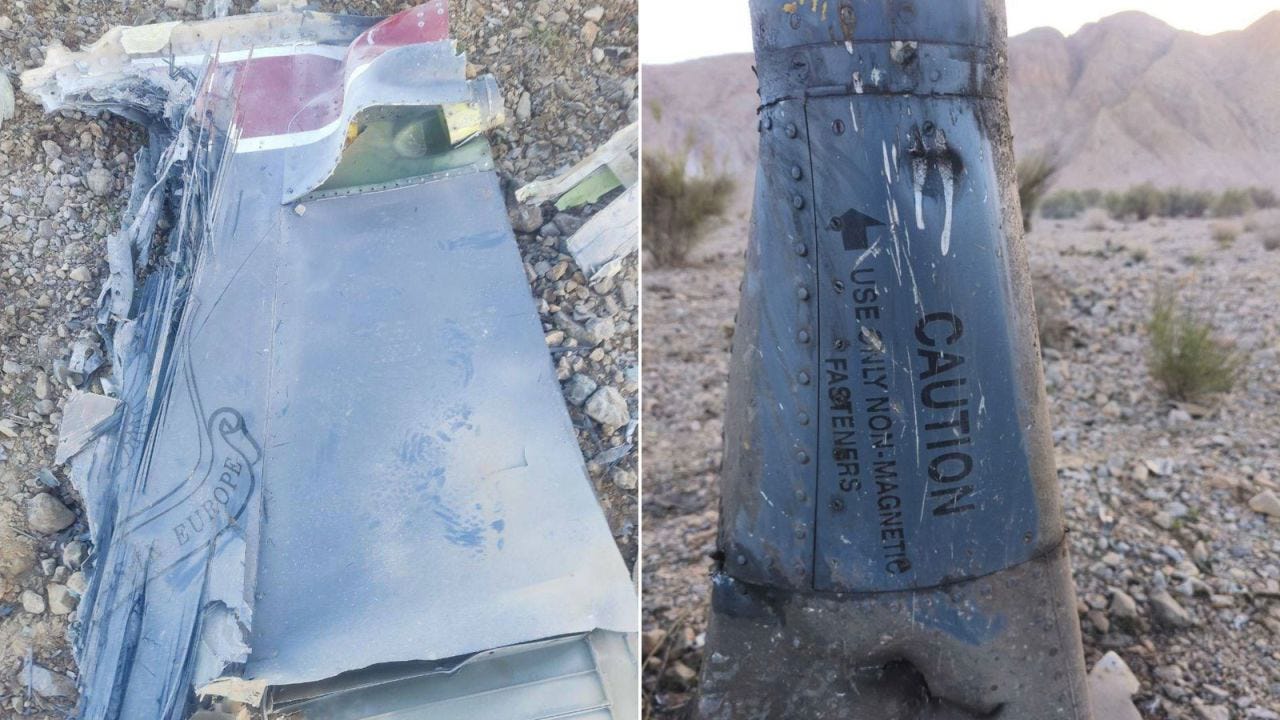
Tail fragment marked for a Europe-based jet, and the ejection-seat caution stencil. Released April 3. Enough to end the argument about whether an F-15 family aircraft came down. Not enough to end the argument about what hit it.
Seventy to a hundred miles an hour, then a mountain
This is the scene the official narrative asks you not to inspect with a calculator.
Bravo said he looked up and saw no parachute. He prayed. He tried to claw fabric loose. Professionals, he said, later estimated from the injuries that he hit at 70 to 100 mph — 113 to 161 km/h. The clips that put him at 100 km/h have the units wrong. A functioning round canopy is supposed to put a man on the ground near 15 mph. Terminal velocity under a streamed or shredded canopy is in the neighborhood of a highway crash. He lived. He called it a miracle. People have lived worse. Aviation medicine has a long file of compression fractures from ejections and hard landings. “Broken back” in that file often means a crushed vertebra, not a cord cut in two. A man can walk on a compression fracture. He will not want to. He will not forget it. He can still put one foot in front of the other if the alternative is Iranian television.
Read the elevation the way a map reads it, not the way a teaser reads it. He did not climb 7,000 vertical feet from the valley floor. The ridge is described as roughly 7,000 feet high — about 2,100 meters, which is ordinary Zagros country. He landed in a valley between cliffs, decided high ground was safer than the place he hit, and moved. That is still a brutal piece of work for a man who has just taken a highway-speed impact with three major fractures, a sprained ankle, and a bleeding face, with no food and almost no water, while a bounty is out on his head and searchers come within a few hundred meters.
60 Minutes did not qualify any of that. It used it. “Never let a lack of motivation put you on Iranian TV” is a perfect line. It is also the line you write when the medical chart would have slowed the hour. Alpha, already back flying according to CBS, would not sit for the same cameras. The program said security. CNN’s sources said he never wanted the show. Both can be true. Only one of them is convenient. The man who came down five miles away and was extracted in hours had less use for the miracle narrative than the man who had to wait. That is not proof Bravo is a composite. It is proof the Pentagon got the crewman who would talk and did not get the one who would not.
The first message Bravo sent after he found cover was some version of “I’m hurt, I’m moving, God is good.” Cooper told O’Donnell those words changed the planning. Now they knew he was alive. Now they knew he was moving. The religious tag is doing double duty: it is what a certain kind of American officer actually sends, and it is what a certain kind of American broadcast actually needs. Neither use makes the climb easier on a fractured spine.
The airstrip is the tell
If the interview is a recruitment poster, the map is the problem the poster cannot solve.
Dude 44 came down in Kohgiluyeh and Boyer-Ahmad, in the southwestern Zagros, on the side of the country that faces Iraq. Early Iranian reports named that province and Khuzestan. U.S. accounts put the jet over a mountainous stretch south of Isfahan on the strike, then put the men on the ground in the southwest. The numbers have always been a little slippery, which is what happens when two governments are narrating the same wreck from opposite sides of a war. What is not slippery is the other pin on the map.
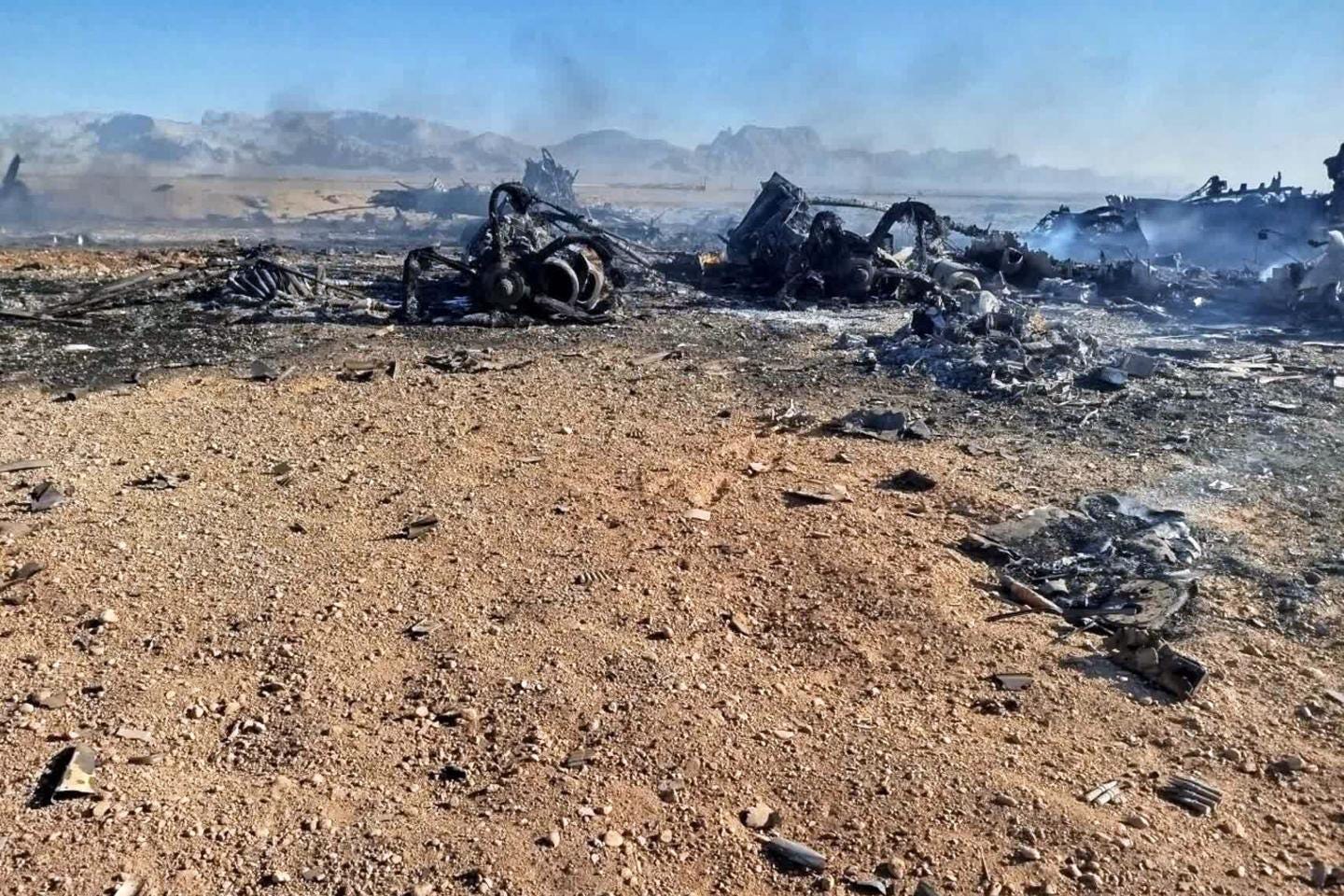
The improvised American strip was an old agricultural field north of Shahreza in Isfahan province — on the order of 200 to 300 kilometers from the crash zone as commonly reported, and tens of kilometers from the Isfahan nuclear complex that holds a large share of Iran’s highly enriched uranium. Two MC-130s bogged in sand. Washington blew them in place rather than let Iran have the avionics. Satellite images later showed burned transport wreckage and rotor hardware on a dirt field that had been scraped usable and then ruined with piled earth so nobody would land there again. Trump admitted the transports got stuck. He did not linger on why that field, that far from the men, that close to the uranium.
A combat search-and-rescue package can use a forward arming and refueling point. Helicopters burn gas. Special operations units pre-plan dirt strips. That is doctrine, not fan fiction. What doctrine does not automatically explain is why the strip that ate two C-130s was laid so far from the crew it was supposedly there to extract, and so close to the one target in central Iran that American planners have spent years war-gaming how to seize or bury.
Iran said the rescue was cover for a uranium snatch. The foreign ministry said it in April. Al Jazeera ran the charge the same week. Western outlets that are not in the business of amplifying Tehran still asked the geographic question out loud. The Spectator Australia called it the Isfahan discrepancy: the downed crew in the southwest, the American dirt field several hundred kilometers northeast, next to the stockpile. NBC had already reported contingency plans to grab or neutralize roughly 1,000 pounds of Iranian HEU — an operation that would need a perimeter, engineers, and an airstrip, and that would keep Americans on the ground for days. A FARP used once is a FARP that can be used again. Hundreds of Americans who walked that ground now know what the ground looks like, where the air defenses sit, and how Iranian reaction forces move.
There is no public proof they lifted a gram of uranium that weekend. Treating the absence of proof as proof of a perfect heist is the same sloppiness as treating Cooper’s press line as proof they never thought about it. The honest position is narrower and worse for Washington. The official rescue story does not explain the location of the strip. The uranium contingency does. The strip was not conjured out of empty desert in an afternoon. It was an existing agricultural field. Someone knew it was there. That is planning measured in months, not in the six hours after Alpha hit the ground.
The scale of the package argues in the same direction. Cooper said more than 90 Americans on the ground, several hundred in the air, up to 5,000 in support. Trump’s April numbers were in the same neighborhood: four bombers, 64 fighters, 48 tankers, 13 rescue aircraft in one accounting. You can move that much metal to pull two men out of a mountain. The United States has done extravagant CSAR before. You can also move that much metal if the two men are not the only objective and the dirt field near Isfahan is not only a gas station. The two explanations are not mutually exclusive. A rescue that doubles as a rehearsal is still a rescue. It is not the story 60 Minutes told.
After the Americans left, the field was wrecked on purpose. Piles of dirt on the runway. Burned hulks. That is standard denial. It is also what you do if you do not want the other side using the same strip next month, or proving how prepared it was this month.
Burned wreckage on desert hardpan from the April operation. The public file has always been richer in fire than in answers about why the strip sat where it sat.
Cooper’s inventory is the small lie that gives the large one away
O’Donnell put the stockpile problem to Cooper on camera. The estimates in circulation were not obscure. About 45 percent of Patriot interceptors already fired. More than half of THAAD gone. Precision weapons being chewed up on a war that has lasted since February. Cooper has testified in Congress about shortages of the munitions required to defend against Iranian missiles and drones. On 60 Minutes his answer was: “I’m not concerned at all. We’re well armed and ready for any contingency.” She asked again, citing the percentages. He was not worried.
That is not analysis. That is a four-star who has already told the legislative branch there is a problem, then sitting under studio lights and declaring the problem does not exist. If the rescue package is a miracle, the munitions package is a press release. They aired on the same night for the same reason. A commander who cannot admit the cupboard is thinning is not a reliable narrator of the cupboard, the cupboard’s location, or the reason two transports died in sand 200 kilometers from the men they were said to be saving.
Trump has used Dude 44 since April the way a campaign uses a flag. We never leave a warfighter behind. We flew an armada. We won in broad daylight. The colonel is safe and sound. Five months later the war is still a political liability, the Strait of Hormuz is still a weapon, and the administration needed the man in the tan suit to make the ledger look like courage instead of attrition. Hegseth’s shop did not invent that need. It acted on it. CNN said political appointees wanted both crewmen. Military officers worried about classified methods. Caine was among those uneasy that an interview could give away how the pickup actually worked. The political shop won. Bravo talked. Alpha did not. The methods that got blurred on screen — the Little Birds, the CIA deception campaign that told Iranians both men were already out, the exact layout of the strip — were the methods a second operation near Isfahan would need again.
Pentagon spokesman Sean Parnell called the pressure story a complete lie and said the department protected sources and methods. The tape that aired protected them by blurring helicopters and skipping the part of the map that makes Isfahan look like more than a backdrop. That is protection. It is also editing.
What the colonel’s age and the missing wreckage do not prove
A strain of commentary around the Iranian-language clips — including the video that sent a lot of people into this argument — treats Bravo’s face as a costume and the sparse wreckage as proof there was no jet. That is a weaker case than the one the map supports.
Colonels look like colonels. The 494th patch on his shoulder matches the unit that flies F-15Es out of Lakenheath. The Aviationist noted the patch in the first technical write-up of the interview. Iran photographed an ejection seat and a tail with European markings the morning of the shootdown, before anyone in Tampa had a chance to build a set. CNN’s analysts said the seat was consistent with the ACES II used on the F-15E. You can argue about missile type. You cannot argue the aircraft out of existence unless you are prepared to argue that Tehran and Washington coordinated a debris shoot on the same morning, then spent two days flying an obvious air bridge over southwestern Iran for no reason. That is a larger conspiracy than the evidence requires.
The missing full airframe is less mysterious than the clips make it. Fighters that hit mountains at speed do not sit on the valley floor like museum pieces. They scatter. Combat search-and-rescue does not pause to inventory every circuit card for Iranian television. The photos that exist are ugly and partial because crashes are ugly and partial. Pointing at a burnt box of avionics and declaring there was no airplane is the inverse of 60 Minutes pointing at a colonel and declaring the war has a soul.
The medical story is in a different category. It is not impossible. It is advertised as effortless. Those are not the same thing. A compression fracture plus adrenaline plus training can move a man uphill. A studio hour that never once slows down to say “this is what ‘broken back’ meant, this is how far he actually climbed, this is how much of the canopy was left” is not doing journalism. It is doing liturgy.
The story they needed, and the story the ground still tells
Put the pieces next to each other and stop asking the tape to be either gospel or a complete fake.
A low American jet was hit over Iran in early April. Both men got out. One was recovered fast. One hid on high ground for two days. The United States built or activated a dirt strip far from the crash and close to Isfahan, lost two transports in the sand, and blew them. Iran hunted the crew and later called the whole thing a uranium raid. American officials said the target that night was drones and missiles, not the nuclear site they kept mentioning in the next clause. Five months later the defense secretary’s political operation wanted both survivors on 60 Minutes. One said yes. One said no. Cooper denied the munitions problem he had already described to Congress. O’Donnell asked the inventory question and accepted the second answer. Critics inside the building had already told CNN the hour was about shaping an unpopular war. The Guardian’s write-up the next morning used the word propaganda and quoted a CBS staffer calling O’Donnell a dimwit used as a tool. That is not Iranian state TV. That is the American media arguing with itself about what it just aired.
A hoax, if the word means anything useful here, is not “the colonel is a mannequin.” A hoax in the useful sense is a story that is true enough to photograph and false enough to function. The jet fell. The men lived. The strip was in the wrong place for the story and the right place for the contingency. The interview was the contingency’s funeral oration: we came for our people, we always will, ignore the dirt field, ignore the percentages, ignore the man who would not sit down.
Trump did not need the hour to invent the war. He needed it to invent an ending that has not arrived. The uranium is still in the tunnels. The interceptors are still a ledger item. The colonel is still a silhouette with a taped nametag. Alpha is still flying and still silent. The agricultural strip north of Shahreza is still a scar with burned aluminum on it.
The official tape asks you to salute. The map, the medical timeline, the missing pilot, the pre-existing field, and Cooper’s inventory denial ask you to keep the tape running after the music stops. That is not a conspiracy theory. It is the difference between a rescue and a narrative, and the reason they put only one of the two men in the chair.
Trump is losing. Trump is desperate and with his record of lie after lie, this one lie can be discredited faster than Trump’s biggest lie of “I’m a winner”.


