

The map of the Middle East is being rewritten again, and this time the rewriting is happening on two fronts at once. In Syria, a country that was supposed to be entering a reconstruction era after the fall of Bashar al-Assad is instead filling with protests, fuel riots, and the old fear that the Islamic State could climb back out of the camps. In Yemen and the Red Sea, Iran-backed Houthi forces have seized the coastline and the islands that sit in the throat of global shipping, while a drone strike from Iraq has forced Saudi Arabia to shut the pipeline it built to escape the Strait of Hormuz.
The two crises are not separate. They are the same regional system cracking in different places. A former al-Qaeda commander now sits in Damascus as transitional president. A kingdom that spent a decade bombing Yemen is asking other capitals for help and being told, by Washington, that the United States will share targeting data but will not open another front. Israel is striking in Syria and Lebanon. Lebanon itself is split between a government trying to disarm Hezbollah and a movement that calls that effort surrender. And in Washington, the loudest argument is no longer how to win the region. It is whether America should stay in it at all.
That argument is being pressed hardest by people who have already paid the personal price of the last two decades of war. Among them is Joe Kent, a retired Green Beret, former CIA paramilitary officer, Gold Star husband, and former director of the U.S. National Counterterrorism Center, who resigned in March over the Iran war and has since argued that American bases in the region have become tripwires rather than assets. His case is blunt: the United States cannot stabilize Syria, cannot bomb the Houthis into a settlement, and cannot indefinitely underwrite every Israeli campaign without creating the next generation of enemies. Deal with tribes. Hunt terrorists. Trade. Walk away from the rest.
Whether that is realism or abdication is now the central question of American policy in a region that is, once again, on fire.
After Assad: A Victory That Did Not Become a State
Assad’s government collapsed in December 2024. Ahmed al-Sharaa — better known for years as Abu Mohammad al-Jolani, the leader of Hayat Tahrir al-Sham and, before that, of al-Qaeda’s Syrian branch — was declared transitional president in January 2025. Armed factions were ordered to dissolve into state institutions. Sanctions began to lift. In August 2026 the United States even removed Syria from the list of state sponsors of terrorism, a designation that had stood since 1979.
On paper, that is a historic reversal. In practice, Syria is still a collection of armed communities sharing a flag.
Al-Sharaa’s government has tried to present itself as a stabilizer: talking to the Kurds, absorbing former rebel brigades, opening to Saudi investment, and joining the global campaign against the Islamic State. The United Nations Commission of Inquiry noted in early September that more than 1.7 million refugees and nearly two million internally displaced people have returned, that a People’s Assembly was established in July, and that the Syrian Democratic Forces announced in late August they were dissolving into state forces. Those are not small facts. They are the raw material of a state, if a state can be built.
The problem is what sits underneath them. HTS was a jihadist organization. Large parts of the new security apparatus are former Islamist fighters, including men who once fought under the banners of groups the United States spent years trying to destroy. Kent and other counterterrorism officials have said plainly that Syria is now run by the former leader of al-Qaeda’s Syrian branch and that much of the armed forces is composed of former al-Qaeda and Islamic State members. The United States, in this view, cannot unmake that fact. It can only decide whether to treat Damascus as a partner of convenience against ISIS or as a new project for nation-building. The last time Washington partnered with Salafi-jihadist networks to remove an Iranian-aligned government in Damascus, the result was a decade of slaughter, the birth of the Islamic State, and a migration crisis that remade European politics.
That history is not an abstraction in Syria. It is the country’s recent past.
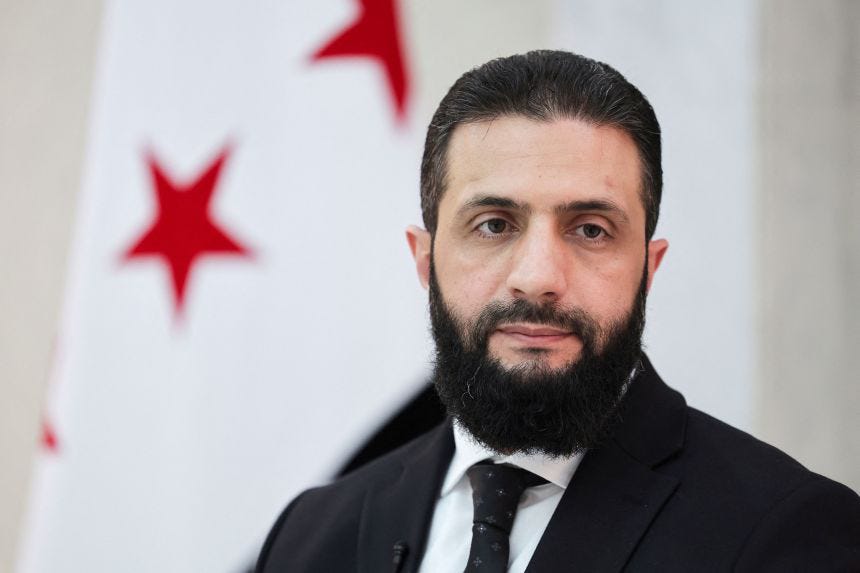
Ahmed al-Sharaa, Syria’s transitional president and former HTS commander, now holds the state he once fought to overthrow.
The Street Comes Back
The protests of 2026 are not a rerun of 2011. They are more fragmented, more economic, and in some ways more dangerous, because they are happening inside a government that has not yet earned a monopoly on force.
ACLED recorded waves of demonstrations through the spring and summer demanding transitional justice and opposing the “recycling” of Assad-era officers into the new security services. The protests clustered in Aleppo, Idlib, Deir ez-Zor, Hama, Homs, and Rural Damascus — the old rebel heartlands, not the Alawite coast. Farmers in the north and northeast came out over wheat procurement prices set too low to compete with neighboring markets. In June the Interior Ministry announced that 3,548 former regime members holding military ranks had been detained since Assad fell. That number was meant to prove accountability. For many Syrians it proved the opposite: that thousands of others were still walking free, still wearing uniforms, still collecting salaries.
Fuel shortages and price spikes have turned political grievance into something more combustible. Gas riots are not ideology. They are the sound of a state that cannot keep the lights on while asking a war-exhausted population to wait for a constitution, a census, and elections that al-Sharaa himself has said could take years.
Sectarian violence has already punctured the transition. Coastal Alawite areas saw mass killings in March 2025. Druze regions in the south have fought government forces and local militias; Israel has struck in support of Syrian Druze and has occupied parts of the old buffer zone in the southwest since the night Assad fled. Kurdish integration, announced on paper, remains a live political fight. Every one of those fractures is a recruitment poster for the Islamic State, which still has fighters in detention camps and sleeper cells in the desert. The camps are not a solved problem. They are a warehouse of future insurgency.
Turkish interests cut across all of this. Ankara wants a Syria that does not empower Kurdish autonomy on its border and does not export refugees. Israeli interests cut the other way: keep Iranian weapons out, keep southern Syria weak, keep a buffer. The new government in Damascus is trying to be a state while two neighbors treat it as a security perimeter.
If al-Sharaa loses control of the factions he absorbed — including men who once fought for ISIS — the collapse will not look like 2011. It will look like 2014: a security vacuum, a prison break, a black flag in a provincial town, and another international coalition assembled too late.
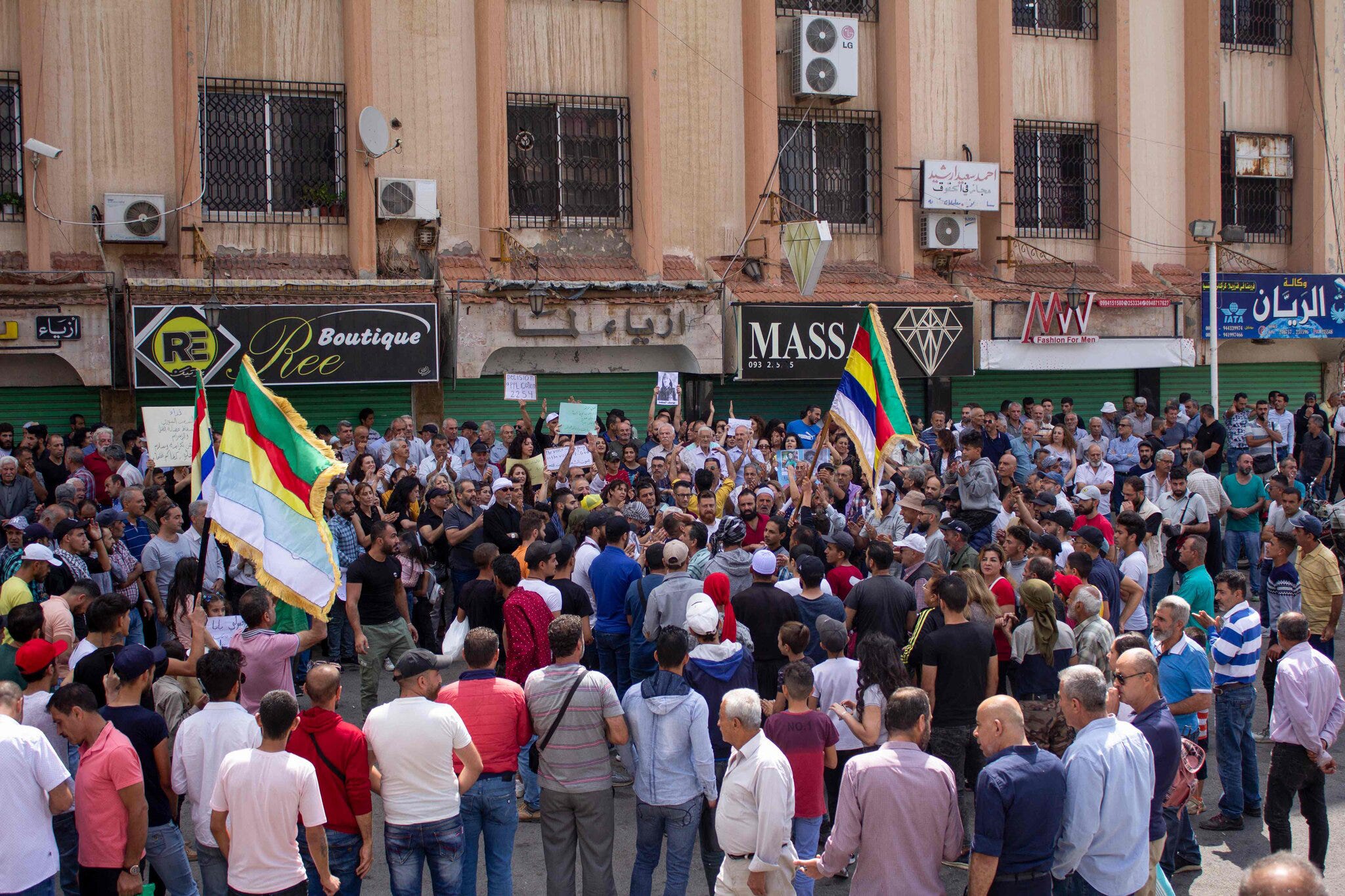
Economic hardship and delayed accountability have brought Syrians back into the streets in cities that spent a decade under siege.
Lebanon: A Deal That Deepens the Split
Syria’s neighbor is not collapsing in the same way. It is polarizing.
A U.S.-brokered framework between Lebanon and Israel, signed in Washington in late June, was sold as a path out of a war that has already killed thousands and pushed Israeli forces more than six miles into Lebanese territory. The bargain is sequential and explosive: the Lebanese Armed Forces would gradually take control of the country as Hezbollah is disarmed; Israel would then withdraw in stages. Hezbollah’s leader, Naim Qassem, called the deal “humiliating, shameful and a surrender of sovereignty” and declared it “null and void.” Lawmakers aligned with the movement warned that forced disarmament would mean internal conflict. Protesters filled Beirut with yellow flags.
Israeli strikes have not paused for diplomacy. Lebanese officials complain that attacks on southern villages, including strikes that have killed civilians, make it harder rather than easier to peel Shiite communities away from Hezbollah. The group’s argument writes itself: the state cannot protect you; we can. The government’s argument is the opposite: as long as Hezbollah remains an armed state within the state, Israel will keep striking and Lebanon will never recover sovereignty. Both arguments are true enough to keep the country paralyzed.
Coup rumors have circulated after major Israeli strike waves, including the April operation Israel called “Eternal Darkness.” Independent researchers later documented how unverified claims — that the strikes had pre-empted an imminent Hezbollah coup — moved from social media into broadcast news. The rumors matter even when they are false. In a country with a memory of civil war, the rumor of a coup is itself a political weapon.
Lebanon’s crisis is therefore not only military. It is a contest over who is allowed to hold guns, who is allowed to speak for the state, and whether a U.S.-designed sequence can survive contact with a population that does not trust the sequence’s authors.
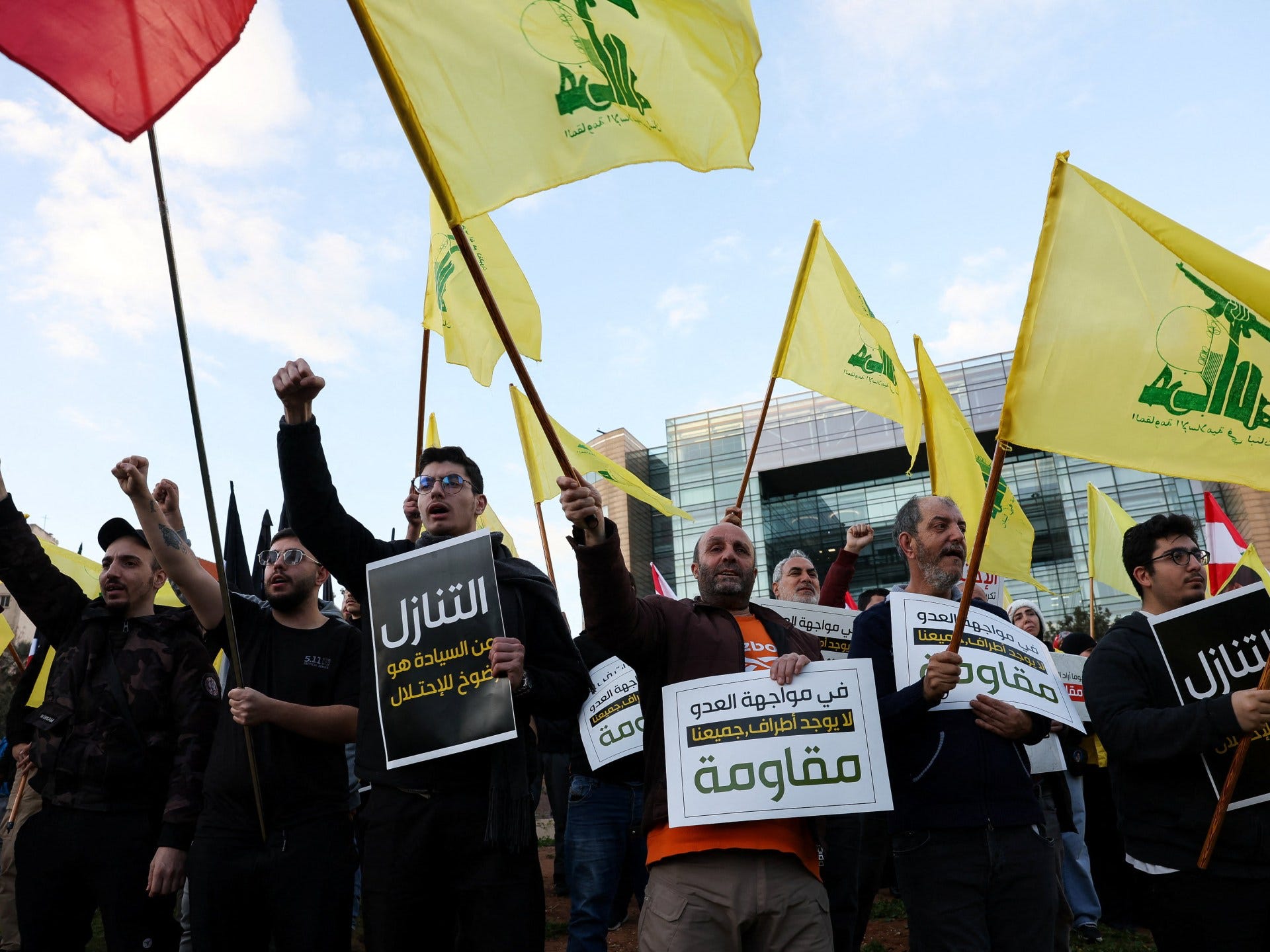
In Beirut, Hezbollah supporters have treated the U.S.-brokered framework with Israel as a surrender rather than a peace.
The Other Collapse: A Kingdom and a Strait
If Syria is a political collapse in slow motion, Saudi Arabia’s problem is mechanical and immediate.
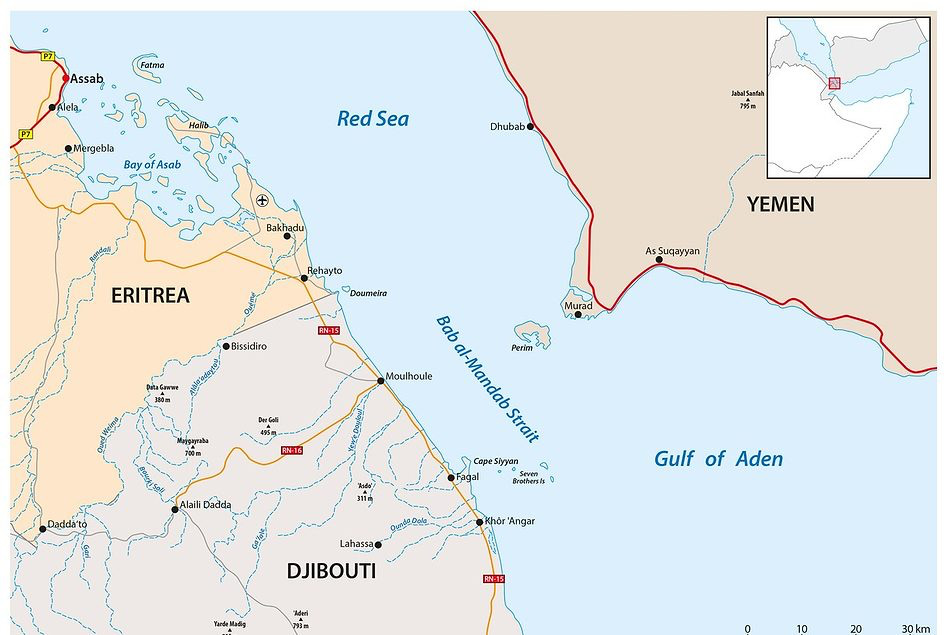
For months the wider U.S.–Iran war has disrupted the Strait of Hormuz, the passage through which most Gulf oil normally leaves the Persian Gulf. Riyadh’s answer was the East-West pipeline, a line built decades ago precisely so Saudi crude could reach the Red Sea without passing Hormuz. Once the war began, the kingdom pushed that pipeline toward full capacity — up to seven million barrels a day toward Yanbu. That made Bab al-Mandab, the narrow gate between the Red Sea and the Gulf of Aden, the new lifeline.
The Houthis noticed.
In a matter of days in mid-September they seized Mocha, pushed down the remaining Red Sea coast, took Dhubab, and captured Perim Island — Mayun — in the middle of the strait. Shipping lanes there run less than three miles from the island. Subsequent reports said they also took the Hanish islands farther north. Vessel crossings through Bab al-Mandab dropped sharply. The group had already declared a blockade of Saudi-flagged shipping. Now it holds the geography that makes a blockade real.
Then the pipeline itself was hit. Saudi officials said drones came from Iraq. Washington pointed at Iran-backed militias. Repair estimates run to three to five weeks. The East-West line, the kingdom’s escape hatch from Hormuz, is shut. Saudi crude supply has already fallen to levels not seen in more than three decades, according to the International Energy Agency.
That is the “worst-case scenario” Saudi officials have been describing: Hormuz constrained by Iran, Bab al-Mandab constrained by the Houthis, and the cross-kingdom pipeline damaged. Three doors. All of them closing.
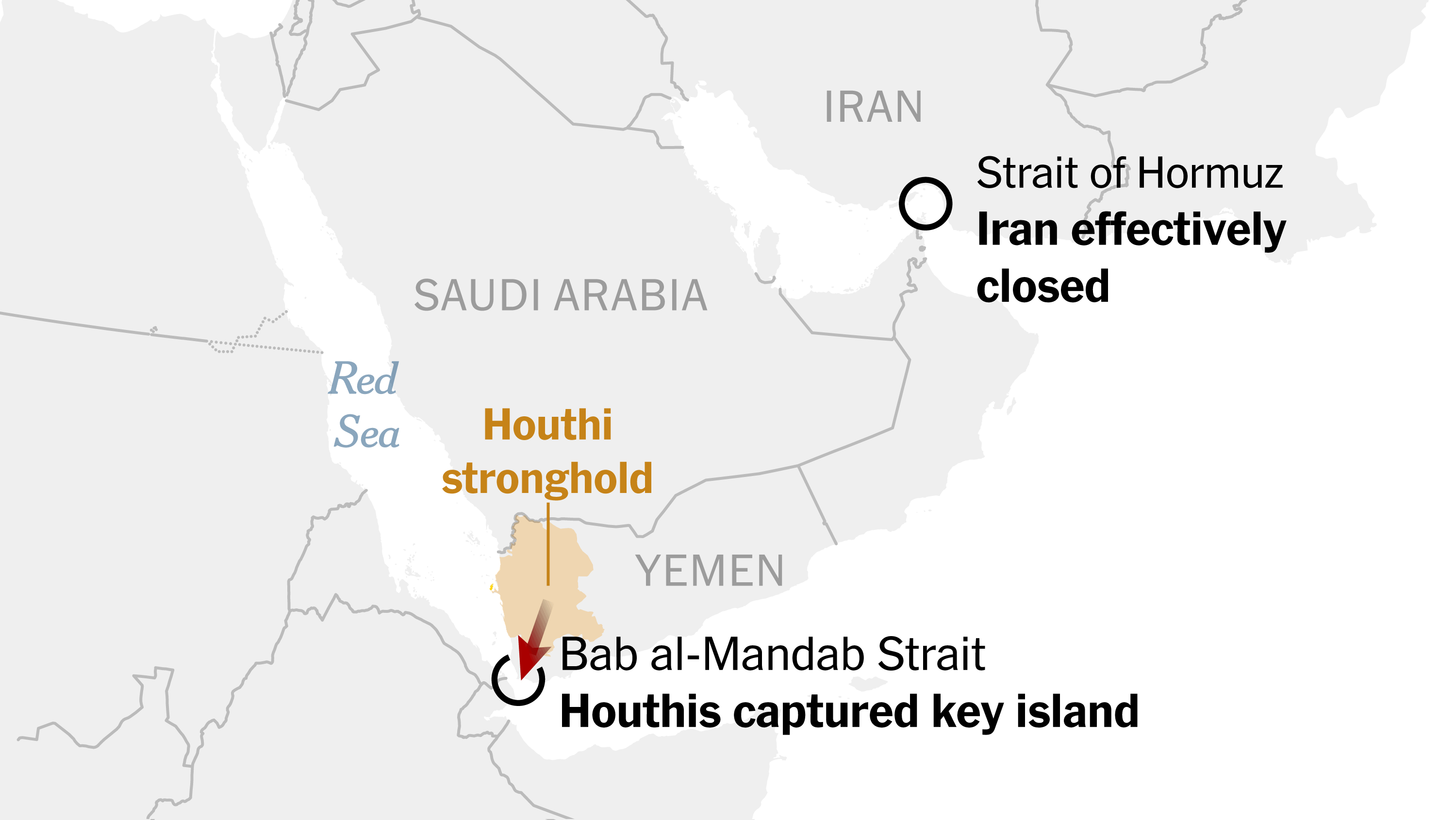
With Hormuz disrupted, Saudi oil was rerouted toward the Red Sea — just as the Houthis seized the island in the strait.
Perim Island sits in the shipping lane. Whoever holds it can threaten every tanker that still dares the passage.
The Houthis are not a conventional army, and Yemen is not a conventional battlefield. Mountains, tribes, and a population that has already survived a decade of Saudi-led air war make a ground campaign a slog. Egypt’s Gamal Abdel Nasser learned that in the 1960s, when his intervention in Yemen became “Egypt’s Vietnam.” Riyadh learned a version of the same lesson after 2015. That is why the current Saudi request is not for another solo war. It is for a coalition.
Crown Prince Mohammed bin Salman called President Donald Trump twice as Mocha fell and asked for American strikes. Trump declined. U.S. officials said the administration would provide intelligence and targeting data, keep about 200 American personnel in advisory roles, and keep the main effort on Iran and Hormuz. Opening a second air war in Yemen, they argued, would stretch an already strained Navy and munitions stockpile. Trump later told reporters the Houthis had contacted Washington and “don’t want to fight with us,” adding that there was “just one country that they’re not too happy with.” He meant Saudi Arabia.
Riyadh has also looked to other capitals, including Israel and Gulf partners. That outreach is a measure of how isolated the kingdom suddenly feels. A state that spent years presenting itself as the indispensable energy power of the twenty-first century is, this month, asking other countries to help it keep oil moving.
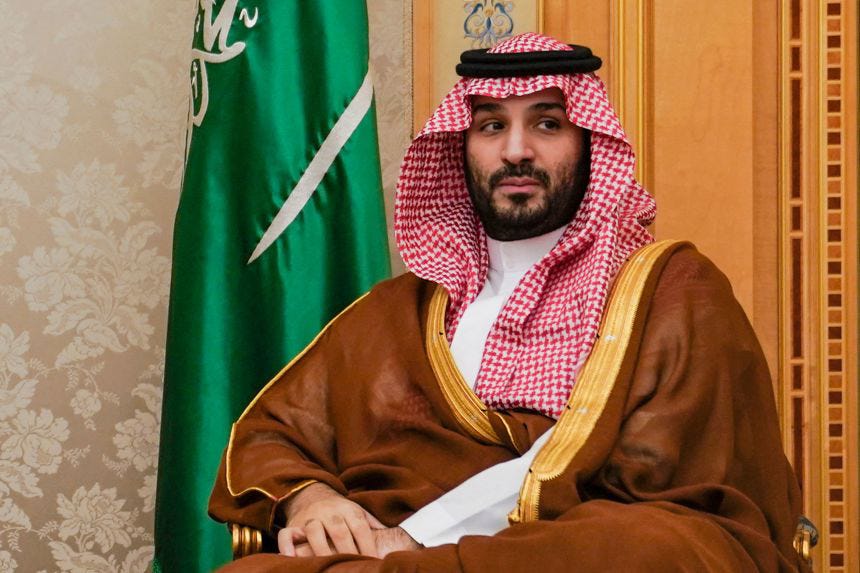
Crown Prince Mohammed bin Salman asked Washington for strikes as Houthi forces overran Yemen’s Red Sea coast. The answer was intelligence, not aircraft.
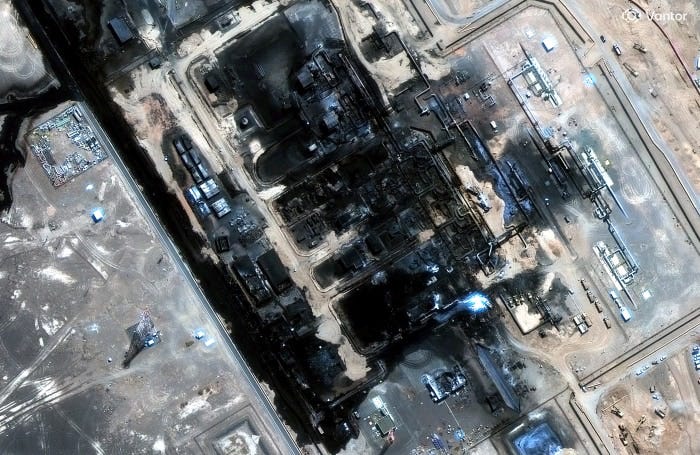
Satellite imagery of damaged Saudi energy infrastructure has become a market-moving image: the kingdom’s backup route is no longer theoretical insurance.
Why Tribal Deals Look Better Than Another Air War
The case against a new Yemen campaign is not only American fatigue. It is the record.
Air power can destroy a radar, a launcher, a pump station. It cannot hold a ridgeline in Saada or buy the loyalty of a tribal sheikh who has survived every foreign intervention since the imamate. The Houthis have taken losses and kept expanding. They have also demonstrated that they can coordinate, or at least coincide, with Iraqi militias and with Iran’s broader campaign to raise the price of energy. Every week of disruption is leverage in a war that is already about chokepoints.
Kent and other skeptics of a new expedition have argued that the workable tools in Yemen are the old tools of the peninsula: money, tribes, ceasefires, and a narrow counterterrorism mission against the groups that actually target Americans. That approach will not satisfy anyone who wants the Houthis erased. It may be the only approach that does not recreate the 2015–2022 war, which killed far more Yemeni civilians than it did Houthi leaders and still left the movement in Sanaa.
Saudi officials know this, which is why their public language has shifted from “we can handle this” in July to “this demands international support” in September. The kingdom is not asking for a theory of victory. It is asking not to fight the last war alone.
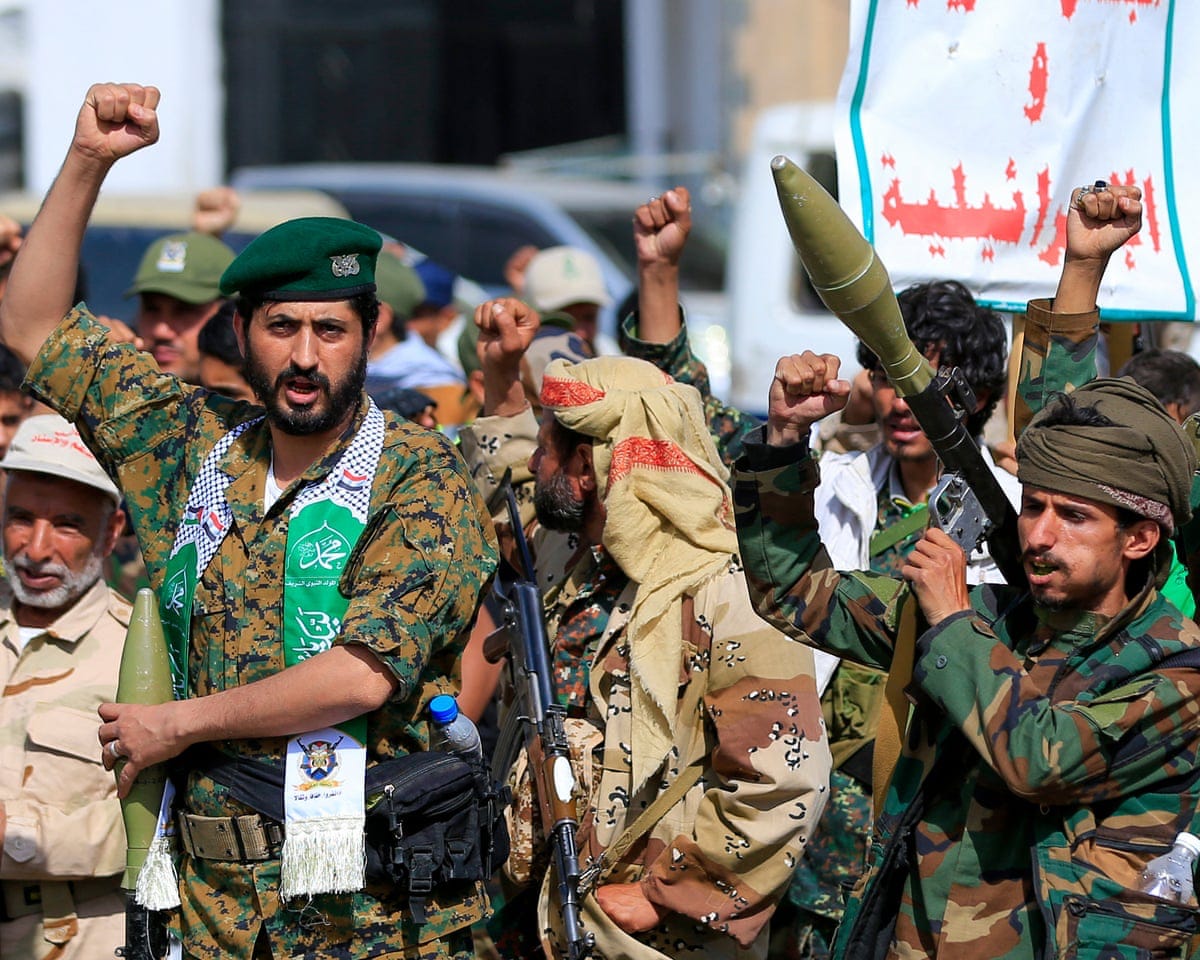
Houthi fighters on the Red Sea coast are now sitting on one of the world’s busiest energy corridors.
Washington’s Split Mind
The United States is fighting Iran, arming Israel, talking to the new Syria, sharing intelligence with Saudi Arabia, and trying not to inherit Yemen. Those are not one policy. They are five policies sharing a flag.
Trump’s refusal to strike the Houthis is consistent with a part of his own record: he does not want another open-ended war in the Arabian Peninsula. It is inconsistent with another part of the same record: the war with Iran, which Kent and other critics say was sold as a short, necessary strike and has become a campaign that puts American bases and sailors in range of missiles every week. Kent resigned as NCTC director in March, writing that Iran “posed no imminent threat to our nation” and that “we started this war due to pressure from Israel and its powerful American lobby.” The White House rejected that account. Trump has said Iran’s activities endangered American troops, bases, and allies. Both versions cannot be fully true. Both are now part of the official record of how the war began.
Kent’s larger argument is about architecture. U.S. bases in the region, he says, have become liabilities. They can be hit. They force Washington to escalate when they are hit. They give adversaries a justification for closing straits and attacking neighbors. Remove the bases, he argues, and you remove the tripwire. Then you can bargain: sanctions relief for freedom of navigation, targeted counterterrorism against ISIS and al-Qaeda, trade with whoever will trade. That is the “walk-away” strategy in its most compressed form. It is not isolationism as a mood. It is a claim about military geography in the age of cheap drones and ballistic missiles.
Critics of that view answer with a different map. If the United States leaves, they say, Iran and its proxies will own Hormuz and Bab al-Mandab. Oil will spike. Israel will act more unilaterally. Syria will slide. Gulf partners will hedge toward China and Russia. The “walk-away” will not be a clean exit. It will be a transfer of chokepoints to the adversary Washington just spent a year bombing.
Both sides are describing real risks. The missing piece in the American debate is honesty about trade-offs. You cannot promise Israel unconditional support, promise Saudi Arabia a security umbrella, promise a light footprint, and promise no forever wars. Those promises collide in the Red Sea this month.
Israel, Gaza, and the Charge of a Blank Check
No regional analysis in 2026 can avoid the Israeli-Palestinian war that still sits under every other file.
Israel’s supporters describe the campaign in Gaza as a war of necessity after the massacres of October 7, 2023: destroy Hamas, recover hostages, make sure no similar attack can be launched again. Israel’s critics, including many governments at the United Nations and a growing share of Western public opinion, describe the scale of destruction, the death toll, and the blockade as meeting the legal threshold of genocide — a charge Israel and the United States reject. The International Court of Justice case and a thick file of humanitarian reporting have not settled the argument. They have made it a permanent feature of diplomacy.
What matters for the present crisis is the political effect of American support. In Arab capitals, Washington’s willingness to arm Israel through Gaza, through southern Lebanon, and through strikes in Syria is read as a blank check. That reading may be unfair to the actual constraints inside the U.S. system. It is not an unfair description of how the policy looks from Riyadh, Beirut, or Damascus. When Saudi officials ask for help against the Houthis and are told that American aircraft are busy elsewhere, they hear a hierarchy of wars: Israel’s wars first, the kingdom’s second.
Kent’s critique goes further. He argues that U.S. policy has repeatedly created the enemies it then has to fight — in Iraq by dismantling the state, in Syria by partnering with jihadists to bleed Assad and Iran, in Gaza by refusing off-ramps that might have returned hostages earlier and limited the war’s duration. Those claims are contested in detail. The pattern he is pointing to is not. Every major American intervention since 2003 has produced a second war that the first war’s authors did not put in the briefing slides.
Atrocities in Syria’s civil war ran in every direction: regime barrel bombs and sarin, rebel executions, ISIS slavery and mass killing. A serious policy has to hold all of that in view. It also has to notice that “stabilizing” a country by blessing whichever armed network just seized the capital is how the last disaster was built.
What a Narrow American Interest Would Look Like
If the United States defined its interests tightly, the list would be short.
First, keep the Islamic State from reconstituting. That is a counterterrorism mission, not a nation-building one. It can be done with intelligence, raids, and pressure on whoever holds the camps — including a Damascus government Washington does not like.
Second, keep oil moving at a price the world economy can absorb. That is a maritime and diplomatic mission. It may require naval presence. It does not require owning Yemen.
Third, avoid a direct war with Iran that American officials cannot explain as a response to an imminent threat against the American homeland. Whether the current war met that test is exactly the argument Kent made when he resigned.
Fourth, stop treating every local conflict as a test of American credibility. Credibility is not a sacred flame. It is a resource. Spend it on the few places where a U.S. treaty or a U.S. city is actually at stake.
A policy built on those four points would look cold from Jerusalem, disappointing from Riyadh, and insufficient from Damascus. It would also look like the policy a country with a $36 trillion debt, a munitions shortage, and a public that no longer believes in transformative war can actually sustain.
Al-Sharaa may yet hold Syria together. He may not. The Houthis may trade Perim Island for sanctions relief and a share of Yemen’s future. They may not. Israel may reach a durable arrangement in Lebanon. Hezbollah may decide that the only answer is another war. None of those outcomes is under Washington’s command. Pretending otherwise is how the United States keeps arriving late to the next explosion and calling the arrival a strategy.
The Week the Map Changed
The images of this week will last longer than the statements. A pipeline blackened from above. A small island in a blue strait. A president in Damascus who used to wear a different name. A crown prince on the phone. Protesters in Aleppo and Beirut who are not asking for democracy so much as for a state that can sell bread and keep the militia next door from becoming the government.
The Middle East has been declared transformed before: in 2003, in 2011, in 2020, in December 2024. Each time the declaration was a little true and a lot premature. What is different now is the stacking of chokepoints. When Hormuz and Bab al-Mandab and the East-West pipeline are all under stress at once, the crisis is no longer regional. It is a price at the pump in Ohio, a factory slowdown in Germany, a budget hole in a country that imports every barrel.
Joe Kent’s answer is to shrink the American surface area until adversaries have fewer things to hit and Washington has fewer reasons to stay. The opposing answer is to hold the line because the line, once abandoned, will be held by someone else. Between those two answers sits the actual government of the United States, which is currently doing a bit of both and hoping the calendar is kinder than the map.
The calendar is not kind. Syria is protesting. Saudi Arabia is asking. The Houthis are on the island. And the men who will decide the next move are working from the same failed briefings that produced the last twenty years — unless they finally admit that the region does not need another American theory of victory. It needs fewer theories, fewer bases, and a much more modest account of what a distant power can actually make other people do.


