

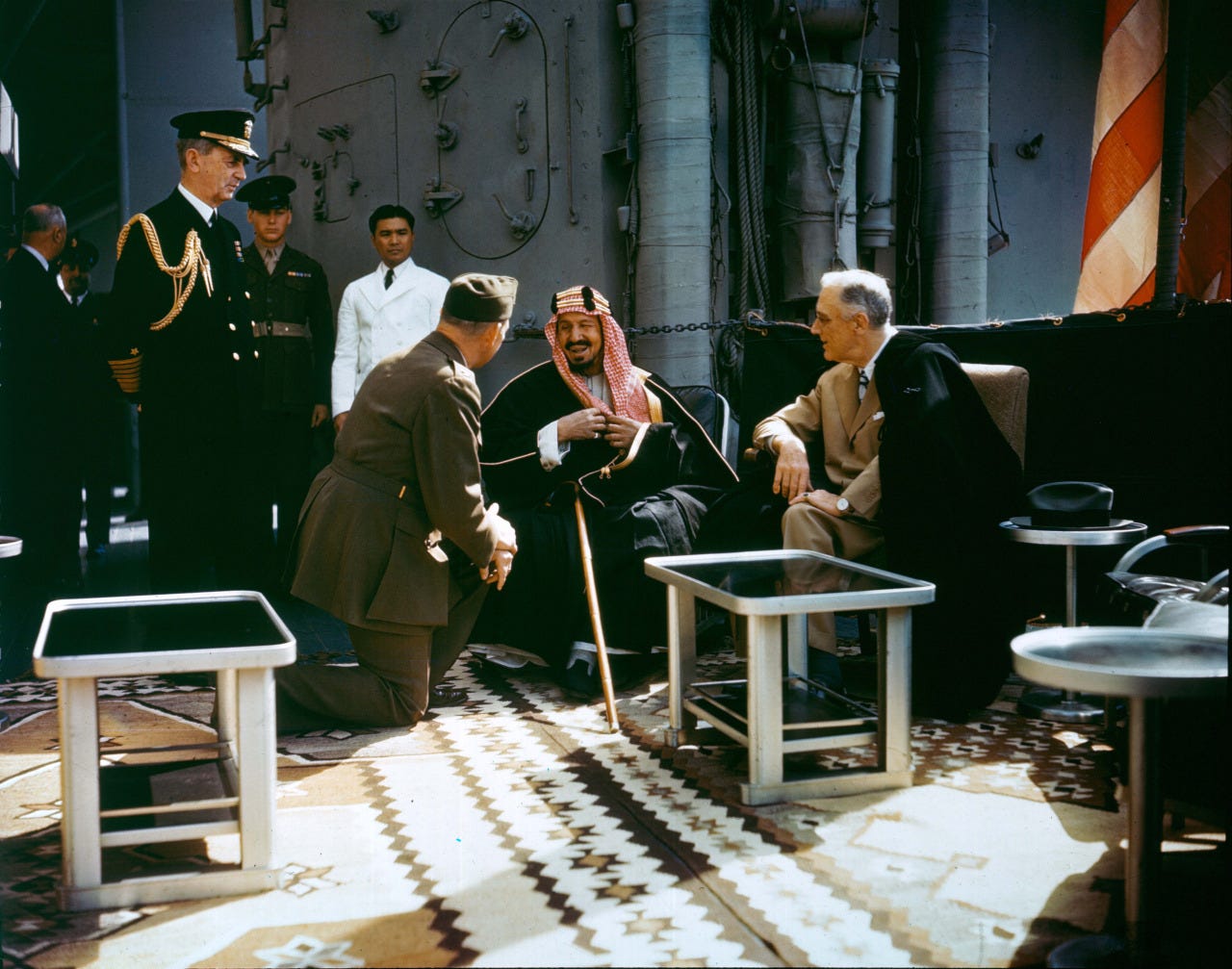
On February 14, 1945, Franklin D. Roosevelt sat aboard the USS Quincy in the Great Bitter Lake and struck a bargain that organized the Middle East for the rest of the American century. King Abdulaziz ibn Saud received a U.S. security guarantee. Washington received privileged access to Arabian oil. The unspoken corollary was that the United States would restrain Israel when Israeli policy threatened the Kingdom. That bargain is now dead. What is replacing it is not a new American doctrine. It is a scramble: Houthi columns on the Red Sea coast, a Saudi oil pipeline burning in the desert, Gulf ministers meeting Iranians in Oman, and a tripartite arrangement among Riyadh, Islamabad, and Ankara that treats Washington as an unreliable patron rather than a security manager.
The argument taking shape among veteran diplomats and regional planners is blunt. U.S. alliances in West Asia are collapsing because the United States no longer delivers the protection it sold. Israel is converting military overreach and international isolation into a strategy that looks, from the outside, like self-destruction. Europe, frozen by the Ukraine war, is repeating the same refusal to talk to adversaries that it now lectures others for. The West is roughly 12 percent of the world’s population and shrinking. The other 88 percent is building other arrangements.
A lightning war on the coffee coast
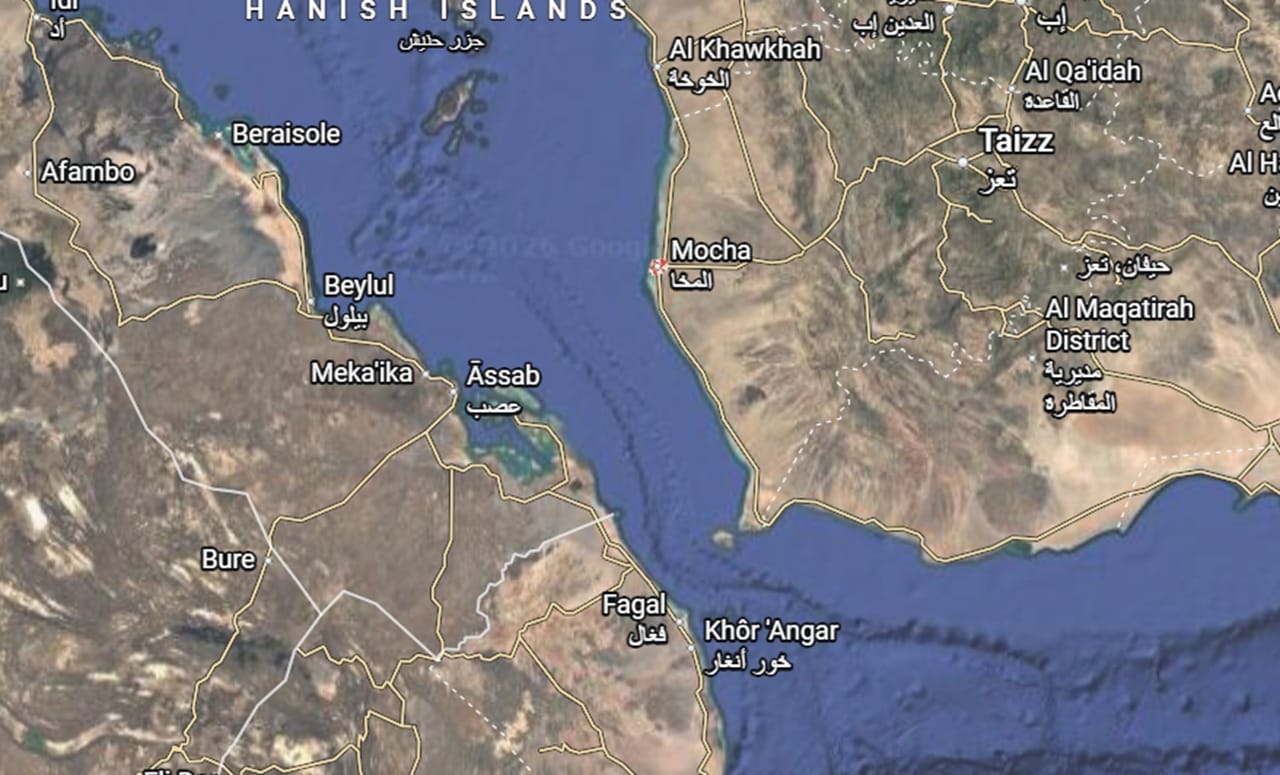
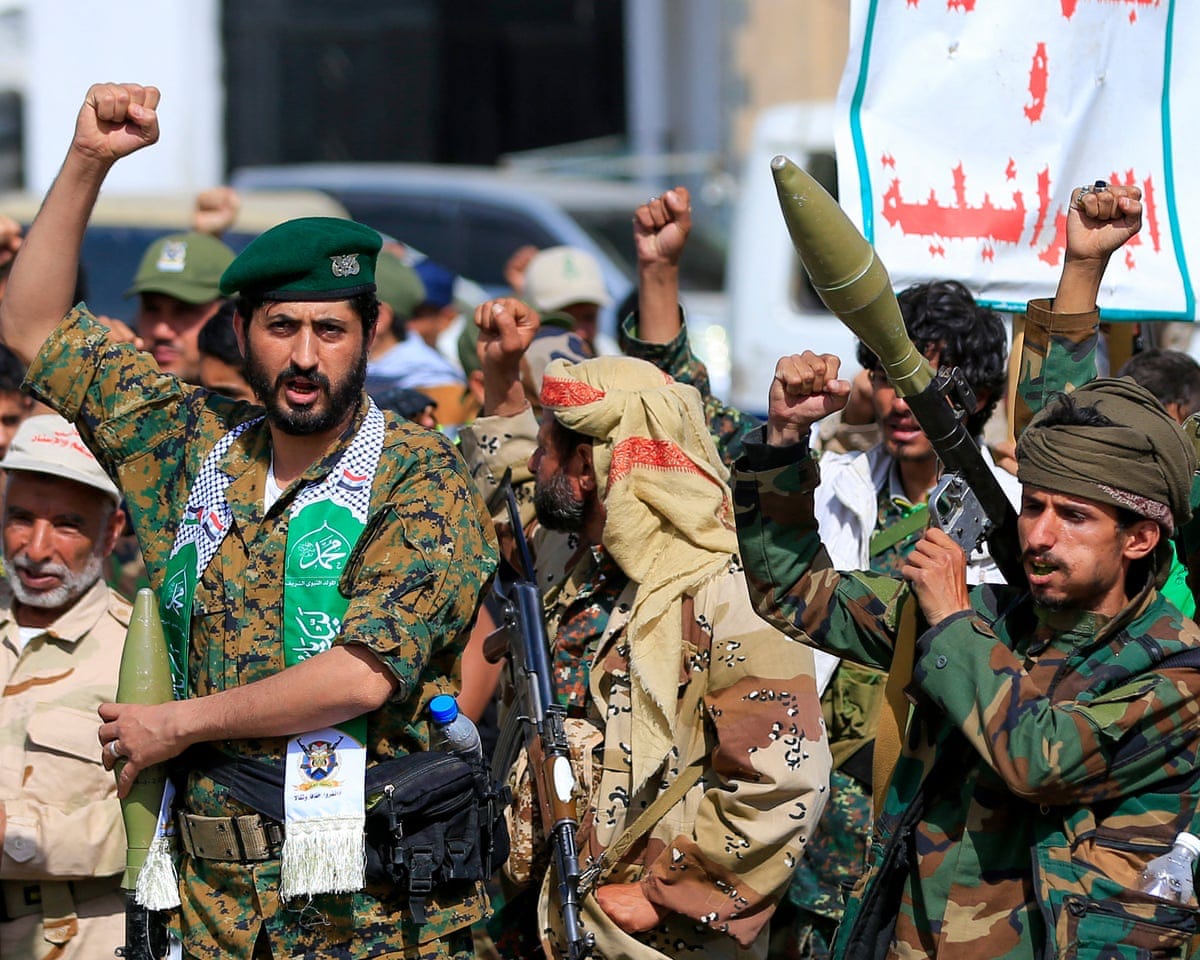
The immediate fuse is Yemen. After a four-year truce, fighting reignited when forces of the internationally recognized Yemeni government — a government that controls perhaps a fifth of the population — attacked Sana’a airport. The Houthis, who hold most of the country, answered with a coastal offensive that stunned Riyadh. In days they took the historic port of Mocha, the town that gave mocha coffee its name when Dutch traders worked the Red Sea in the sixteenth century, then Dhubab, then islands in the approaches to the Bab el-Mandeb, the narrow strait that funnels traffic between the Indian Ocean and the Suez Canal.
Saudi aircraft answered with more than 300 sorties. Houthi missiles and drones hit radar sites, ammunition dumps, airfields, and hangars inside the Kingdom. A separate strike, which Riyadh blamed on Iran-aligned Iraqi militias, knocked out a node on the East-West pipeline — the remaining overland route that was supposed to get Saudi crude to the Red Sea after the Strait of Hormuz became too dangerous. Diesel in the United States climbed above $6 a gallon. Trucking and farm equipment felt it first. American voters care more about the pump than about the wars that move the pump. A political reckoning is already on the November calendar.
There is no plausible military solution visible from Riyadh. The Houthis have reached the water. Saudi Aramco cannot reliably export through Hormuz or Bab el-Mandeb or load at Yanbu for the Mediterranean. Vision 2030 projects are being curtailed. American equipment in Saudi inventories cannot be easily replaced; Washington spent down stocks and political capital in the war with Iran. Crown Prince Mohammed bin Salman asked President Trump more than once for American airstrikes. Trump refused, offering intelligence and targeting data instead, and publicly noted that the Houthis had told him they would hit Saudi targets, not international shipping. That distinction is cold comfort in Riyadh. It is also a public admission that the old protector will not fight this war.
The geography is unforgiving. Mocha sits on the eastern shore of the southern Red Sea, opposite Eritrea’s Assab. From there the coast runs down toward Perim Island and the throat of Bab el-Mandeb, where the shipping lane compresses into a corridor that no tanker captain can avoid. Control of that coast does not give the Houthis a blue-water navy. It gives them range, radar horizon, and the ability to turn insurance rates and transit times into weapons. Saudi Arabia spent a decade trying to contain that threat with a mix of airpower, money, and a United Nations-backed political process. The process froze. The airpower did not produce a decision. The money did not buy loyalty in Sana’a. The coastal breakout is what a frozen war looks like when one side decides the freeze is over.
Salalah and the return of Iranian mediation
On September 14, Iranian Foreign Minister Abbas Araghchi sat with Gulf Cooperation Council ministers in Salalah, Oman — a city near the Yemeni border whose palaces still carry the mark of Indian craftsmen. The hope in some Gulf capitals is that Mohammed bin Salman will authorize his foreign minister to ask Tehran to mediate with Ansar Allah and break the escalation chain. The alternative is a Saudi admission of defeat. Peace with Iran is no longer a preference. After the Hormuz war it is a requirement.
Araghchi is expected to press a second demand: that GCC states remove U.S. bases used, in Iran’s telling, to wage a war of aggression and wreck Iranian infrastructure. Whether Riyadh, Abu Dhabi, or Manama accept that language is another matter. The geometry is already changing. A BRICS summit in New Delhi condemned the war on Iran and demanded it end. Oman and Iran have discussed managing Hormuz transit themselves. If the GCC blesses that idea, it pulls the rug from under a U.S. blockade that is already expensive to sustain — long supply lines, damaged facilities, a Fifth Fleet headquarters in Bahrain that has taken hits, and a fleet whose readiness no longer matches the rhetoric of permanent presence. Senior officers have privately conceded damage and a more defensive posture in Jordan that official talking points deny.
Saudi Arabia is therefore shopping for a different security system. The Pakistan–Saudi–Turkey arrangement is the one regional planners watch most closely. Pakistan brings nuclear weapons, manpower, and a China relationship. Saudi Arabia still brings money, even if it is now borrowing from the World Bank — a signal of distress, not of abundance. Turkey brings an advanced economy and a formidable army. Together they amount to an explicit repudiation of U.S. management of Persian Gulf and West Asian security. Israel is alarmed for a reason. A bloc that is not beholden to Washington is a check on any “Greater Israel” project that assumes American cover will always be there.
The 1945 photograph is now an artifact. Roosevelt and Abdulaziz built a system in which American power subsidized Saudi security and Saudi oil subsidized American industry. Washington’s non-response to earlier Houthi strikes on Abqaiq already told Riyadh the subsidy was over. The current war confirmed it. Alliances do not collapse in a single communiqué. They collapse when the weaker partner discovers that the stronger one will not show up.
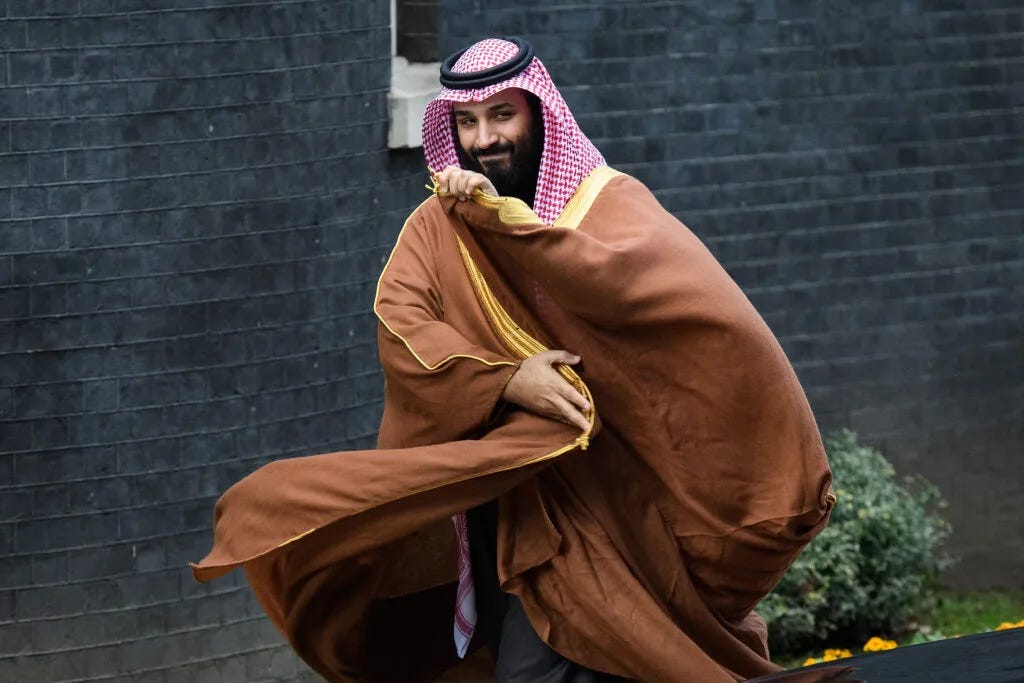
Mohammed bin Salman’s problem is not only military. It is fiscal and political at once. Vision 2030 was a bet that the Kingdom could buy time — diversify the economy, entertain the young, and remain the swing producer of global oil while American protection held the ring. Two closed straits and a damaged east-west pipeline wreck the cash-flow assumption underneath that bet. A state that must borrow while it is bombing Yemen is not a state executing a grand strategy. It is a state looking for a ceasefire it can survive.
The broken habit of talking
Islamic statecraft has an old line attributed to Muawiya: if a single hair still connects you to another party, yield when he pulls and pull when he yields — never lose contact, never give up the dialogue. The United States and much of Europe have forgotten that habit. Since 2011, Washington cheered the fall of Hosni Mubarak, failed to stabilize what followed, and ended up aligned in Syria with factions that include veterans of the jihad the United States once swore to destroy. The pattern is not strength. It is improvisation dressed as principle.
The same allergy to negotiation is visible in Ukraine. NATO expansion and the project of tying Ukraine to the Alliance validated the Russian claim that a hostile military structure on the border was intolerable. The 2022 invasion was reckless and also, from Moscow’s vantage, a war it had spent years signaling it would fight. Istanbul talks that year were sabotaged. Europeans prohibited themselves from speaking to Moscow. Ukrainian long-range strikes on Russian refineries, guided by Western intelligence, remind the Kremlin why it went to war and make a diplomatic off-ramp harder, not easier. The destination now in view is a rump Ukraine: more corrupt, de-industrialized, stripped of grain-export leverage, governed by western-Ukrainian nationalists whom Poles and Hungarians will not love, and locked out of both NATO and the European Union. Ukrainians are unlikely to reconcile with that defeat. A hard winter is coming. Russia is preparing to end the war by force because no one on the other side has a diplomatic answer.
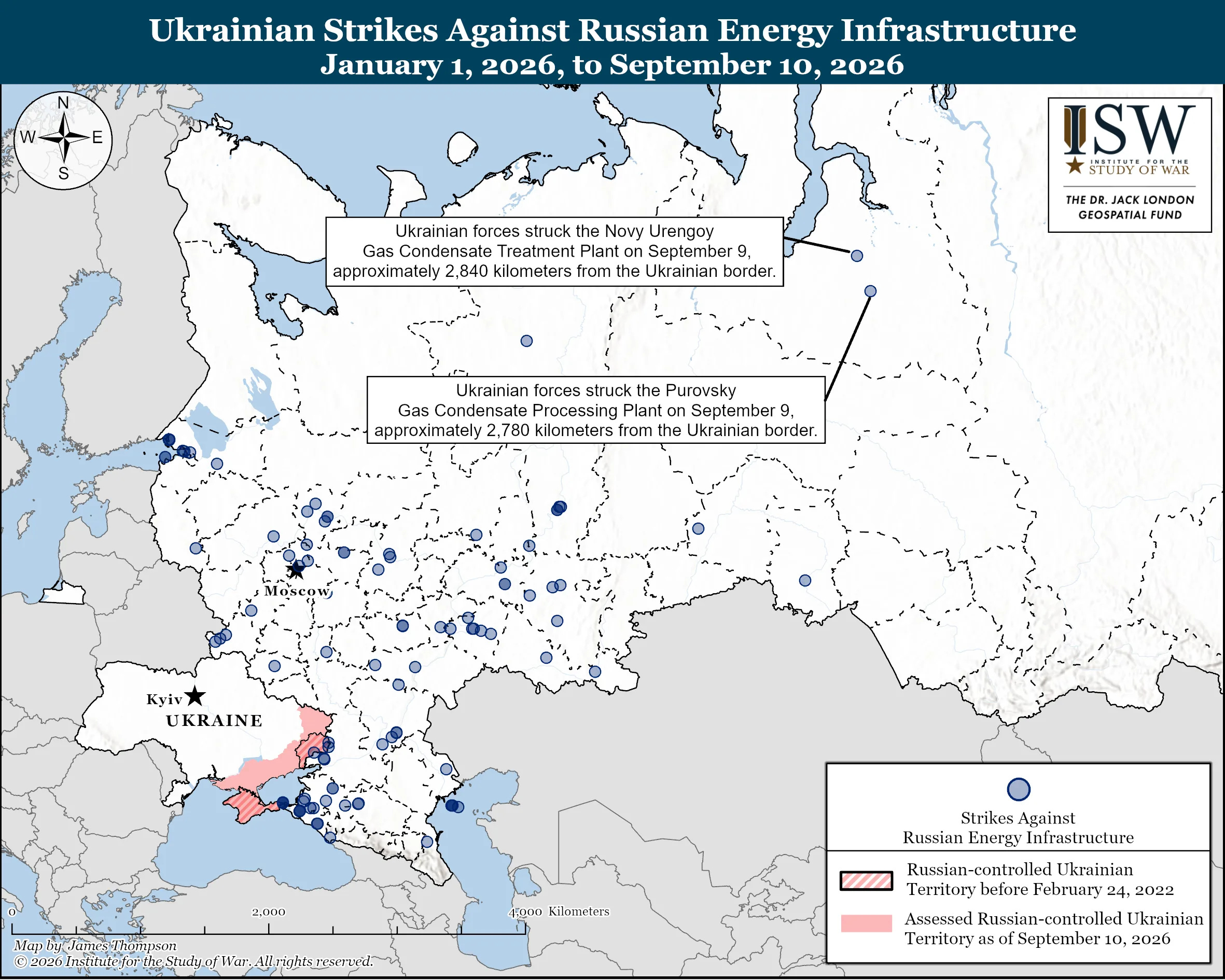
The parallel is not moral equivalence. It is professional diagnosis. A power that cannot talk to its enemies also cannot reassure its friends. Saudi Arabia learned that at Abqaiq and again this month. Israel is learning it as European governments edge away and American patience frays. Ukraine is living it.
Energy knits the two theaters together. Ukrainian hits on Russian refining capacity tighten diesel and gasoline markets already strained by Gulf disruption. Western officials present those strikes as leverage. Markets experience them as shortage. A strategy that treats Russian export infrastructure and Arabian export infrastructure as separate problems is a strategy that does not look at a fuel gauge.
Israel, isolation, and a strategy without an end
The sharpest question hanging over the region is not whether Israel can win the next raid. It is whether Israel still has a theory of survival that does not depend on permanent American rescue. International support has evaporated even in parts of the West that once treated criticism of Israeli policy as unsayable. The United Kingdom and a cluster of European countries have moved, however cautiously. Israeli professionals and intellectuals are leaving in larger numbers. The IDF is strained across Gaza, the north, the West Bank, and the wider regional fight; officers have warned that the force can break if it is asked to hold every front at once. The political split inside Israel is between a tradition of parliamentary democracy and a cabinet current that speaks of “voluntary” Palestinian departure from Gaza and the West Bank and of resettling the Strip. Retired generals have said they are horrified by what they have seen in the West Bank.
Gaza has been reduced to a landscape of craters and emptied blocks. Israel is fighting on multiple fronts. The diplomatic cost has become a strategic fact, whatever legal name one assigns to the campaign. Egypt and Jordan, the Camp David partners, are restless. Turkey and Israel contest the future of Syria — Ankara wanting a single state, Jerusalem more comfortable with a mosaic of communities that can be played against one another. Iran’s price for any larger settlement with Washington includes an end to Israeli campaigns against Palestinians, Lebanese, and Syrians. Israel defies that demand.
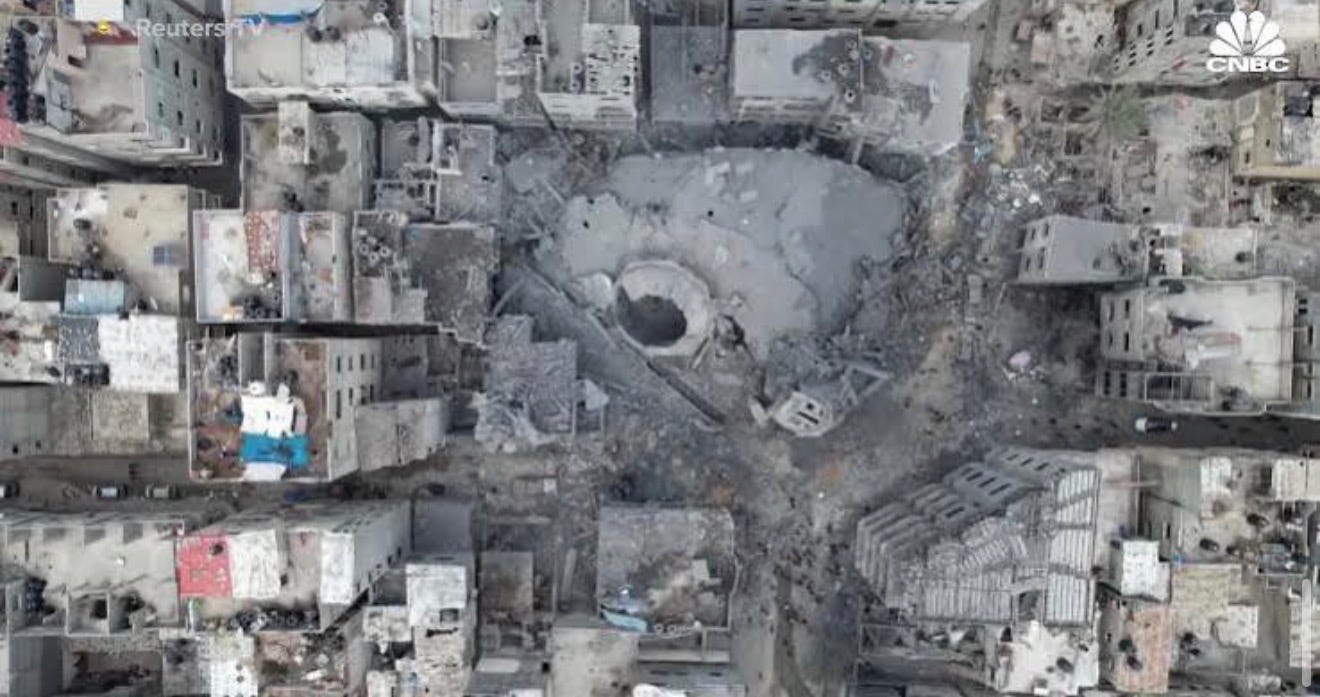
The question Israelis ask is where the Palestinians are supposed to go. The question hanging over the next decade is where Israeli security goes if the state cannot make peace with the people among whom it was planted. Analogies to the Crusader kingdoms — small armed polities that lasted a century or less once their overseas patrons tired — are now uttered in rooms that would have treated them as heresy ten years ago. The underlying claim does not require those analogies. A small state that lives by pointing a gun at everyone around it, and that assumes the American gun will always be in reserve, does not have a survival strategy. Time, which Israeli strategy treated as an ally, is no longer obviously on its side.
Technology has not solved the political problem. Precision weapons and targeting software can kill faster. They cannot produce a neighbor who accepts the result. They cannot replace the legitimacy that leaks away when images of destroyed cities define a country for a generation of viewers who never sat through the older arguments about 1948 or 1967. A state can win every tactical engagement and still lose the environment in which those engagements were supposed to produce safety.
The “Greater Israel” conversation makes the problem worse, not better. Expansion as ideology assumes a surplus of force and a surplus of American patience. Both surpluses are smaller than they were in 2006, 2014, or even 2023. A Pakistan–Saudi–Turkey concert changes the correlation of forces in ways that planning documents written for a unipolar Gulf did not budget for. Nuclear ambiguity in Islamabad, Turkish drones and a large standing army, and Saudi money — even borrowed money — are not a NATO substitute. They are a reminder that the region can organize violence and deterrence without asking Washington first.
Energy, midterms, and the price of distance
The Red Sea and Hormuz are not abstractions. They are the plumbing of industrial civilization. When both ends of the Arabian Peninsula are contested, crude that used to move on automatic schedule becomes a political event. Ukrainian hits on Russian refineries tighten the same market from another direction. American domestic politics remains almost vulgar in its simplicity. Voters do not rank Yemen, Gaza, or Donbas above the cost of filling a tank. A president who declined to bomb the Houthis for Saudi Arabia may still own the inflation that follows from two energy wars at once. That is the box visible in mid-September, weeks before the midterms.
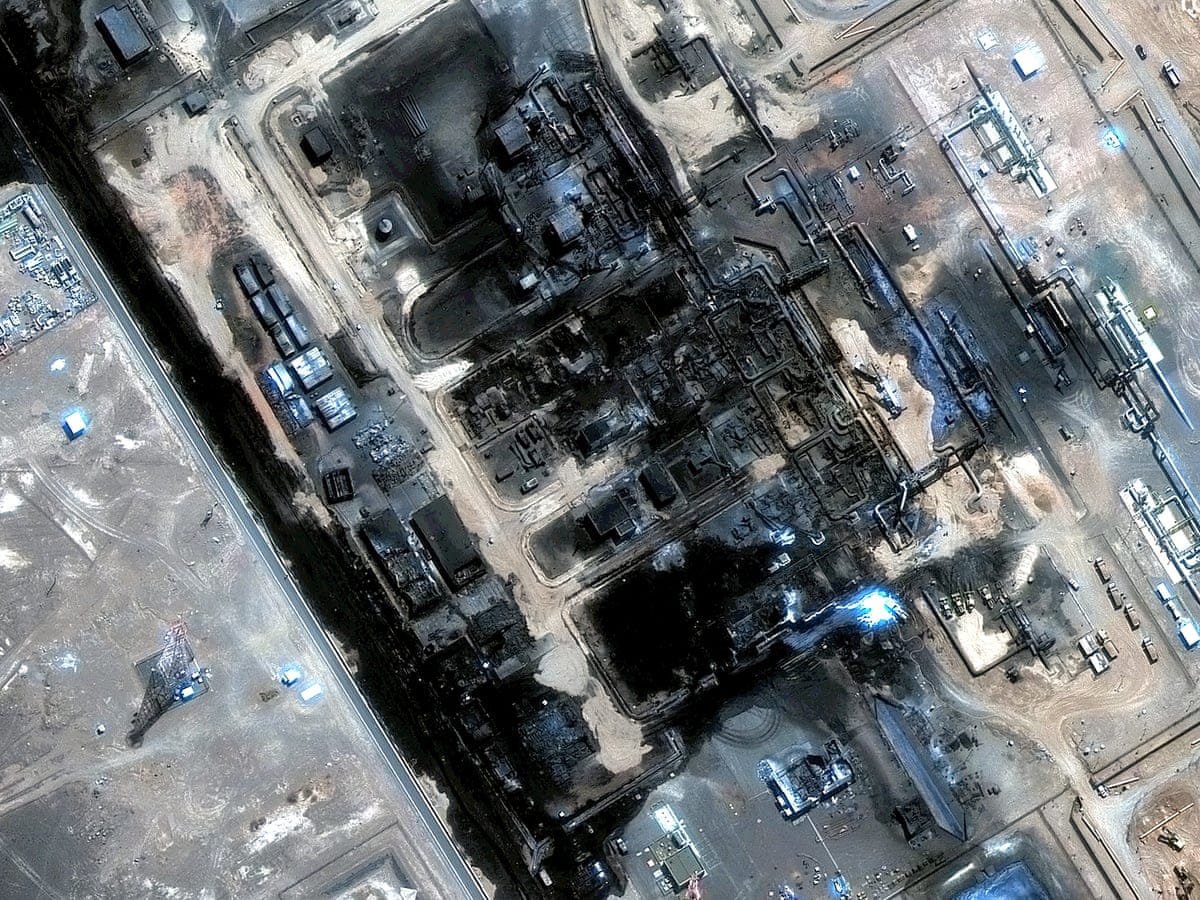
Satellite pictures of blackened pump stations in the Saudi desert are the visual companion to that argument. So are pictures of a tanker on fire in the Bab el-Mandeb and of fighters lifting rocket-propelled grenades in Mocha. Geography has reasserted itself. Sea power still matters, but only if the ships are maintained, the bases survive, and the local partners believe the carrier will come. The inventory of naval fatigue and damaged Gulf facilities is meant to show that the hardware of hegemony is no longer keeping the political promise.
Insurance markets understood this before speeches did. War-risk premiums on Red Sea transit spiked when the Houthis first began shooting at ships tied, in their rhetoric, to Israel and then to a wider set of flags. A Houthi position on the Mocha–Perim line turns a sporadic threat into a standing one. Combined with Hormuz risk and a damaged Saudi pipeline, the result is not a cinematic energy apocalypse. It is a grinding re-pricing of everything that moves by diesel, from harvests in the American Midwest to container schedules into Europe.
Washington’s public line has been that the Houthis are a manageable nuisance if they spare American hulls. Riyadh hears a different sentence: your tankers are your problem. That is how alliances feel when they end. Not with a treaty denunciation. With a targeting distinction.
What replaces the status quo
The West still treats the post-1945 and post-1991 orders as sacred. Debate about alternatives is treated as a kind of heresy. Meanwhile BRICS, for all its contradictions, is practicing something the United Nations was supposed to embody and often does not: rules that require consensus among unlike powers rather than instruction from a shrinking club. The homely image is traffic lights that work because everyone agrees they work, not because one driver owns the intersection. The Global South is not converting to American liberalism. It is building workarounds.
None of this requires believing that China, Russia, Iran, or the Houthis are virtuous. The method is older than the unipolar moment. Count capabilities. Watch who will actually fight. Watch who will talk. Watch who can still export oil. On those measures, the United States is still a giant, but it is a giant that has spent down the credit it accumulated in 1945 and 1991. Saudi Arabia is acting like a state that has noticed. Israel is acting like a state that has not. Europe is acting like a continent that has outlawed the conversation it needs to have with Moscow and therefore cannot end a war it cannot win.
The meeting in Salalah will not redesign the world. A Houthi checkpoint on the road to Bab el-Mandeb will not sink the U.S. Navy. A midterm election will not restore the Quincy bargain. What they can do, together, is make visible a transition that polite official language still refuses to name. The American system in the Middle East was never only bases and arms contracts. It was a promise that the United States would manage the region’s violence so that oil moved and allies slept. That promise is no longer priced into Saudi planning, Iranian diplomacy, Turkish ambition, or Israeli strategy — except as a hope that someone in Washington will reverse course.
The counsel that follows is unfashionable. Talk to the people you have been told are untouchable. Admit when a war has no military ending. Stop treating a shrinking share of the world’s population as a permanent veto over everyone else. Whether governments take that advice is another question. The Houthis are already on the coast. The pipeline has already burned. The old photograph on the Quincy is already history.
What comes next will be messier than the system it replaces. A Gulf that must live next to Iran without an American referee will make ugly compromises. A Pakistan–Saudi–Turkey triangle will not be a concert of democracies. An Israel that cannot end its wars will keep generating the isolation that its supporters call antisemitism and its critics call consequence. A Ukraine that cannot join NATO and cannot recover its industry will sit on Europe’s eastern edge as a wounded, revisionist fragment. None of those outcomes was inevitable in 2011, or even in 2022. They are the residue of wars that were supposed to be short, of alliances that were supposed to be automatic, and of a great power that confused the habit of being needed with the fact of being able.
The Red Sea is the place where that confusion became visible in a single week: jets over Yemen, smoke over a pipeline, ministers in Salalah, and a White House that would not send the strike package Riyadh asked for. History rarely dates itself so cleanly. This time it did.


